My research connects neutrino–nucleus measurements, neutron detection, and detector performance across emulsion and water Cherenkov experiments.
NINJA
2024–present
A J-PARC-based nuclear-emulsion experiment measuring neutrino–nucleus interactions with exceptional spatial resolution and low momentum thresholds. I contribute to the analysis of final-state kinematics, using reconstructed hadrons to test how neutrino interactions are modeled on water.
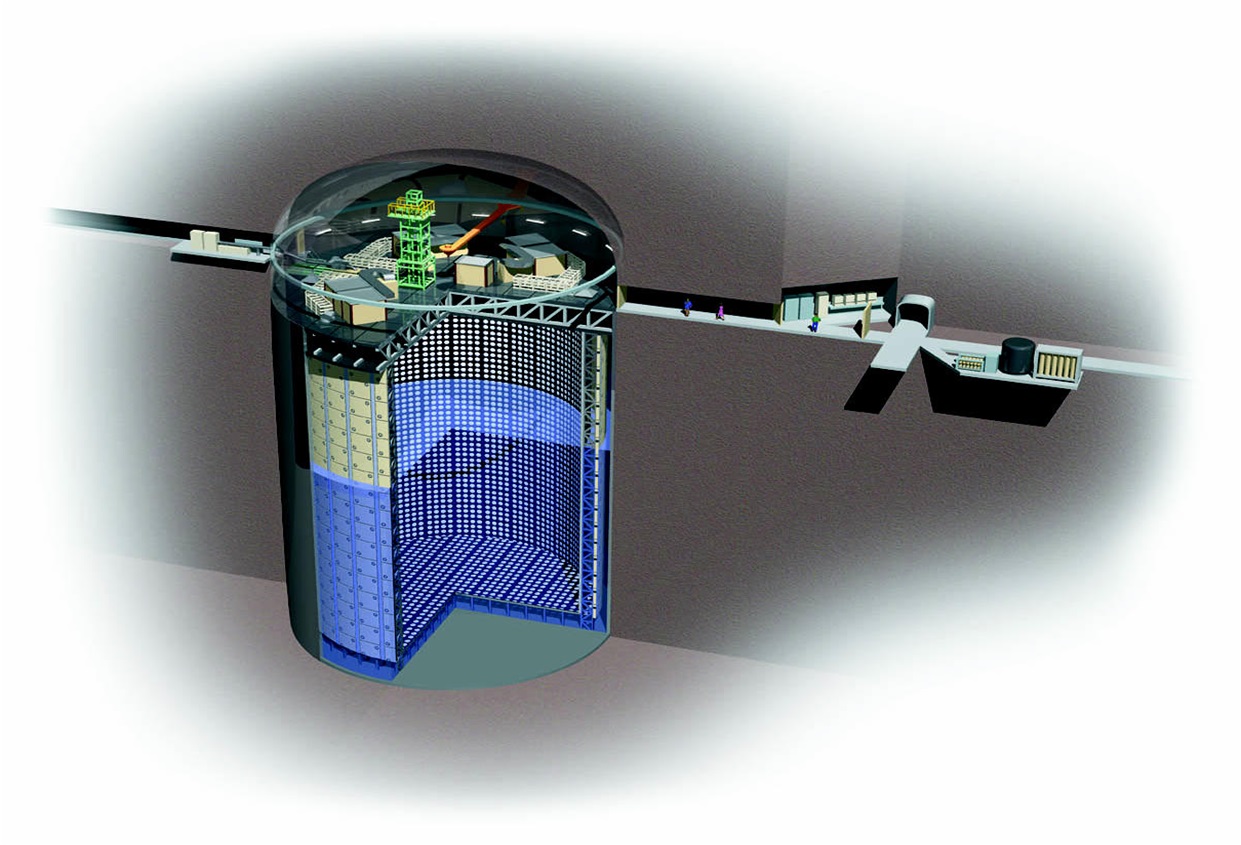
A next-generation water Cherenkov observatory designed for precision neutrino measurements, neutrino astronomy, and searches for nucleon decay. As a member of the collaboration, I am extending my experience with neutron signals and water-detector reconstruction toward the next generation of neutrino measurements.
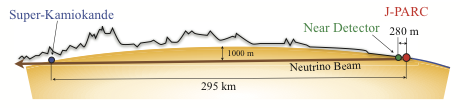
A long-baseline neutrino oscillation experiment transmitting a beam from J-PARC in Tokai to Super-Kamiokande, 295 km away. I have contributed to neutron-tagging work in the accelerator-neutrino program, where delayed neutron signals provide information about the interaction and help distinguish neutrino from antineutrino events.
The T2K neutrino beam line. Credit: T2K Experiment.
A 50-kiloton water Cherenkov detector in the Kamioka mine used to study atmospheric, solar, and accelerator neutrinos and to search for proton decay. My doctoral work established and calibrated neutron detection across the pure-water and SK-Gd phases, then measured neutron multiplicity and track length in atmospheric-neutrino interactions. I also compared the data with hadronic interaction models to test how nuclear effects and neutron production are represented in simulation.